
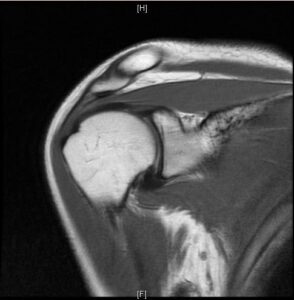
Shoulder MRIs are full of intimidating terms: tendinosis, partial tearing, labral degeneration, arthritis, bursitis, rotator cuff damage. Most people read that report and assume surgery is next.
Not necessarily. Here’s the question that actually matters: do your symptoms match what the MRI shows?
An MRI shows structure. It doesn’t tell us how much pain you should have, how strong you are, or what you can safely do. We see it all the time: terrible-looking MRIs with barely any symptoms, and miserable shoulders with pretty clean imaging. The picture and the person don’t always line up.
And when they don’t line up, that’s the whole point. If your MRI shows a cuff tear but you can lift your arm and your strength is improving, what exactly would surgery fix? You’d be operating on an image, not on the problem.
MRIs are useful, but they’re a snapshot, not a verdict. Lots of these findings are just wear and tear. Research has found cuff tears, labral changes, and arthritis on scans of people with no shoulder pain at all, especially as we age.
So we start with the person, not the picture. A real shoulder eval looks at strength and endurance, range of motion, which movements hurt versus which are just weak, shoulder-blade mechanics, tolerance for lifting and reaching, and what your work or sport actually demands.
Then we compare. If your symptoms match the imaging (you can’t lift your arm, night pain won’t quit, and the MRI shows a full-thickness tear), a surgical consult makes sense. If they don’t match, it’s worth a serious conversation before anyone operates based on the image alone. Imaging still matters, and some findings do need a surgeon. We’ll tell you when that’s the case. But for most shoulders, the right question isn’t “what does my MRI show?” It’s “how is my shoulder actually doing?”
At Altius, we evaluate the shoulder you actually have, not just the one on the scan. You’ll get:
Got a scary MRI report? Contact us through phone or email to discuss with a therapist.